 EN

Countertop Assembly Labor Versus Back-of-House Storage Density
Saving three cents per unit on an unfolded die-cut pastry sheet looks like a smart procurement win until three morning baristas spend two hours every shift folding corner tabs by hand. When operations directors evaluate bakery packaging design across multiple retail storefronts or central commissaries, the choice between flat-pack lock-corner blanks and machine pre-glued auto-bottom cartons dictates daily labor flow and backroom shelf capacity. A flat-pack lock-corner box ships completely unglued as a single flat sheet cut and scored on a platen press. Because zero glue seams overlap inside the master shipping carton, flat sheets stack with maximum density, fitting hundreds of units into a tight under-counter cabinet. However, every single box requires manual pre-breaking along four score lines and interlocking four corner hooks before a pastry ever touches the board. Conversely, a pre-glued crash-lock or four-corner glued tray passes through a high-speed folder-gluer at the manufacturing plant. Although the overlapped glue flaps double the stacked thickness inside shipping cartons, kitchen staff simply pinch two opposite diagonal corners and pop the box into a rigid three-dimensional tray in about two seconds.
Score-Line Crease Mechanics and Cold-Chain Adhesive Integrity
Whether a carton pops open smoothly or fights the operator's fingers comes down to die-cutting rule depth and adhesive chemistry. Under European Carton Makers Association structural codes and ISO 536 paperboard grammage rules, heavy food-grade ivory board and kraft linerboard develop strong elastic memory. If a factory scores the crease lines too shallowly on a flat-pack box, the side walls spring outward and unhook the corner tabs whenever a moist cake or heavy tart sits inside. Optimizing structural assembly across both flat and pre-glued formats requires locking down three manufacturing variables:
-
Crease channel width to board caliper ratios: Matching the female matrix channel width on the die-cutting platen to the exact micron thickness of the paperboard allows 180-degree pre-breaking on folder-gluers without cracking the outer clay coating or matte lamination.
-
Freezer-grade ethylene-vinyl acetate and metallocene adhesives: Standard warm-weather packaging glues turn brittle and snap open inside walk-in blast chillers; specifying cold-chain adhesive formulations ensures pre-glued six-corner trays stay bonded at sub-zero storage temperatures.
-
Nick placement and stripping tolerance: Leaving clean, burr-free edges around locking slots stops paper dust from falling onto frosted pastries during rapid countertop erection.
Operational Comparison Across Bakery Box Structural Formats
Matching structural dielines to hourly packing volume, warehouse pallet space, and retail price tiers prevents both backroom storage overflows and fulfillment bottlenecks.
| Structural Format | Erection Time Per Box | Warehouse Stacking Density | Bottom Load Integrity | Ideal Bakery Buyer & Operational Fit |
|---|---|---|---|---|
| Flat-Pack Lock-Corner Box | 15 to 25 seconds (manual tab locking) | Maximum, ships as flat unglued sheets | Moderate, relies on corner tab friction | Small neighborhood cafes, low-volume custom cakes |
| Pre-Glued 4-Corner & 6-Corner Tray | 2 to 3 seconds (single push-down motion) | Moderate, double-wall folded glue flaps | High, continuous side walls resist bowing | High-volume wholesale commissaries, donut lines |
| Auto-Bottom (Crash-Lock) Carton | 3 to 4 seconds (pinch-and-pop base) | Moderate, diagonal bottom fold thickness | High when paired with inner base card | Private-label retail families, vertical pastry boxes |
| Collapsible Pre-Glued Rigid Box | 5 to 8 seconds (peel-and-stick corner magnets) | High compared to set-up rigid boxes | Superior, heavy greyboard core structure | Luxury holiday gifting, artisanal chocolate sets |
The operational matrix above highlights a critical crossover threshold: once a bakery or commissary packs more than three hundred boxes per shift, the hourly wage spent folding unglued lock-corner tabs completely wipes out the lower unit price of flat-pack blanks.
Field Lessons from a Boston Multi-Storefront Commissary Upgrade
Treating structural engineering as an afterthought during seasonal scaling can bring a commercial packing line to a standstill. During a fourth-quarter holiday expansion for a Boston-based multi-location bakery and grocery wholesale supplier, the operations team ordered eighty thousand flat-pack lock-corner window boxes across five SKU sizes to minimize warehouse pallet rent. As daily holiday pie and pastry orders tripled in November, the central commissary hit a severe labor wall. Packing line workers wearing food-safe nitrile gloves struggled to thread the tiny die-cut locking hooks into the corner slots at speed, resulting in torn tabs on eight percent of the cartons and requiring four extra temporary workers per shift just to pre-fold empty boxes. Worse yet, when stacked four high inside refrigerated delivery vans, humid chiller air softened the unglued side walls, causing the bottom boxes to buckle under TAPPI T 825 compression loads. Re-engineering the five-SKU family into a locked pre-glued six-corner tray system with an integrated auto-locking lid resolved the crisis immediately. By running pre-broken crease lines and cold-chain hot-melt adhesive through rigorous assembly checkpoints at the factory, commissary staff popped boxes open with one hand, cutting packing labor hours by sixty percent while surviving refrigerated van stacking without a single crushed corner.
Balancing Buyer Tiers and Sourcing Scalable Packaging Systems
No single structural format serves every tier of a growing food business equally well. Wholesale white-label operations moving tens of thousands of daily units prioritize pre-glued four-corner trays with locked board calipers and repeatable batch pricing that integrate cleanly onto automated or fast manual packing belts. Private-label brands managing five to eight seasonal SKUs often combine pre-glued auto-bottom cartons for core items with flat-shipped collapsible rigid boxes for holiday gifting, maintaining unified print and foil finishes across the entire shelf block without renting extra warehouse space for empty air.
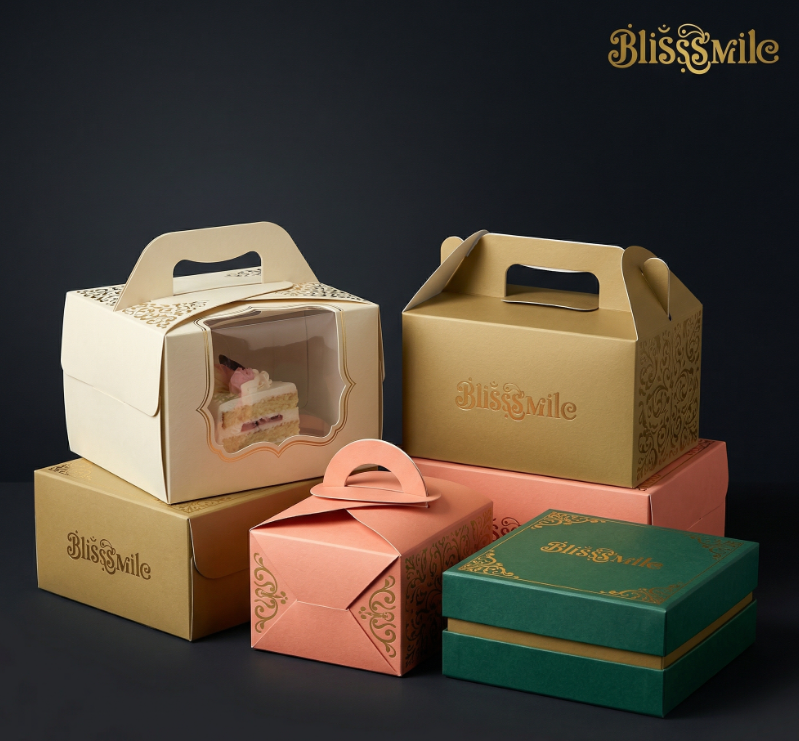
For wholesale distributors, private-label bakery brands, and luxury gifting confectioners seeking predictable structural performance from initial brief to final delivery, BlissSmile engineers complete, scalable packaging systems rather than isolated boxes. Guided by a transparent four-step workflow, five strict quality-control checkpoints covering materials, structure, print, assembly, and packing, and archived reorder-ready documentation, the team delivers locked specifications and fast five-to-ten-day reorder turnarounds worldwide.
Table of Contents
- Countertop Assembly Labor Versus Back-of-House Storage Density
- Score-Line Crease Mechanics and Cold-Chain Adhesive Integrity
- Operational Comparison Across Bakery Box Structural Formats
- Field Lessons from a Boston Multi-Storefront Commissary Upgrade
- Balancing Buyer Tiers and Sourcing Scalable Packaging Systems